




We build the capacity of organisations in low-income countries and help them prepare to host humanitarian volunteers.
April 2020
HOW TO PREPARE FOR RISK? HOW TO PROTECT FRONTLINE VOLUNTEERS?
These days we are becoming increasingly aware of the importance of volunteering. Volunteers are often on the front line, willingly facing challenges that carry a degree of risk or danger. The safety of volunteers is crucial for ADRA as a sending organisation.
Adra Slovakia, together with European partners in the TEHV project, is building the capacity of future host organisations in seven countries around the world. Currently, two online trainings have been successfully completed.
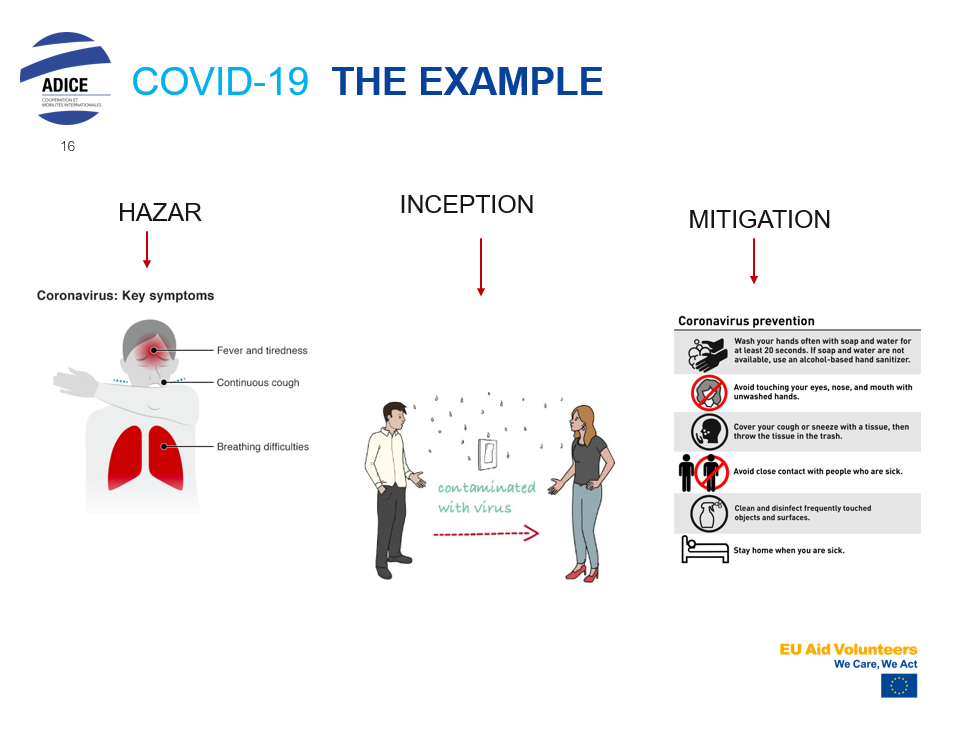
In the first training we focused on risk management and the creation of safety rules. What risks can volunteers face? What is their severity and likelihood? What measures to take to eliminate them?
„It's a public holiday, 10 o'clock in the morning. You wake up and there are three messages on your phone. One from a volunteer, one from the local hospital and one from your partner organisation. It says the volunteer has survived electrocution.“ We also solved such dilemmas in the second part of the training focused on the creation of a communication plan, communication in an emergency or further steps such as evacuation.
June 2020
We did it! We have applied for EU Aid Volunteers certification.
All the preparation is usually done in face-to-face meetings, but this year we were forced to move online for the first time. For the last few months we have been training, advising, reviewing and helping our partners create and set up a bunch of standards and processes leading to safe, effective and meaningful humanitarian volunteering.
Keep your fingers crossed that our partners will be successfully certified and will be able to carry out humanitarian volunteer missions with us next year!
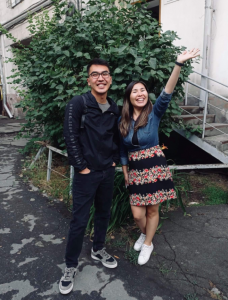
Here are some happy moments from the day of the certification:

October 2020
HOW TO REPORT ETHICALLY ON DEVELOPMENT ISSUES IN THE MEDIA?
We discussed this issue yesterday at a joint training session with partner organisations preparing to host future EU Aid Volunteers. The more media outlets are created and try to capture the attention of their readers and the more the public relies on information from social networks, the more emphasis we should put on ethics in reporting on the activities of humanitarian and development organisations in low-income countries. Media literacy and critical thinking are helpful in distinguishing what is objectively and ethically reported and what, on the contrary, already violates the dignity of the people portrayed and helped by development projects on the ground.
Together with the trainer Boba Markovič Baluchová, we learned the basics of media content creation, interviewing methods, as well as manipulative techniques in creating headlines, accompanying photos and the articles themselves, thanks to a theoretical lecture and subsequent practical exercises. Explaining the phenomena of poverty marketing, the white saviour complex or „voluntourism“, as well as adhering to the rules of the code of ethics in the creation of outputs from volunteer stays were also part of the training.
The eighth training is part of the TEHV - Towards Effective Humanitarian Volunteering project, which brings together partners from 10 countries to share their experiences.

November 2020
ANOTHER COMMUNICATION TRAINING BEHIND US
After the first training, which focused on the ethics of communication on development and humanitarian aid, the second one was more about the technical side of communication. By the way, Boba Markovic Baluch, our trainer for the previous training, recently gave an interview about ethics, but especially about media and information literacy, which you can listen to here: https://www.mixcloud.com/docunion/o-potrebe-mediálnej-a-informačnej-gramotnosti-v-čase-pandémie/
This time, together with our colleagues from ADRA CZ and Adice Association shared their experience with non-European partners in the field of working with different communication platforms, planning communication activities, as well as proper communication and organisation of events. Colleagues from ADRA Czech Republic on the example of their successful „I'm running to Mali“ campaign, they provided valuable advice on fundraising communication.

December 2020
HOW TO BUILD MEANINGFUL AND SUCCESSFUL VOLUNTEERING PROJECTS?
It is a difficult but not impossible task. Developing a needs assessment is a great start. Meeting the needs of each party - the volunteer, the host organization, and most importantly, the community - is key.
The second step is to closely monitor each phase of the project and thoroughly evaluate its impact so that we can continuously improve our work and achieve our goals.
To better understand the rationale and importance of these steps, a three-day capacity building training for our partners was held. Expertise was provided by three Slovak trainers from PDCS. They showed us different theoretical approaches and practical tools that we could try out during this very interactive training.
You can see how to keep the interactivity of such a training when instead of a big meeting in a conference room in snowy Bratislava, 15 organisations from 21 countries meet in the online space of Zoom here:

Thank you to our 32 colleagues, both trainers and interpreters and facilitators from sending organisations (ADRA CZ, Adice Association, MTÜ Mondo) for their participation and cooperation. Fingers crossed that the host organisations will be able to successfully put the knowledge into practice.
The training was part of three projects: HVA - Humanitarian Volunteers in Action, SudHAV3 - Sustainable Development through Humanitarian Aid Volunteers 3, TEHV - Towards Effective Humanitarian Volunteering, which are supported by the EU Aid Volunteers programme.
June 2021
DISASTERS, BOTH NATURAL AND MAN-MADE, HAVE DEVASTATING IMPACTS, ESPECIALLY IN LOW-INCOME COUNTRIES
Natural disasters and other calamities have caused 1.3 million deaths in the last 20 years, 93% of them in so-called developing countries.
How can we ensure the safety of vulnerable communities in areas at high risk of floods, earthquakes and other disasters? This week we trained with our partners in disaster risk reduction and management. Organisations in Armenia, Cambodia, Kyrgyzstan, Lebanon, Nepal, North Macedonia and Serbia are now better prepared to assess risks in their locations and take action to protect local populations from devastating disasters.


HOW TO HELP IN AN EMERGENCY SITUATION
Floods, earthquakes, fires or the covid-19 pandemic. How can humanitarian organisations be more effective in helping people affected by natural and other disasters? An organised approach is the key. From setting up a makeshift base, to monitoring needs, to material and volunteer assistance, to long-term financial and psychosocial support, each step has its irreplaceable place in the aid chronology.
ADRA Czech Republic, which has extensive experience in flood response, has trained us and our partners from Armenia, Cambodia, Kyrgyzstan, Lebanon, Nepal, Northern Macedonia and Serbia. Shortly after the training, we had the opportunity to observe the work of Czech Adra on the ground when a devastating tornado hit the South Moravia region. Here too we saw how important professional coordination of humanitarian intervention and volunteers is to ensure that aid is effective and well directed.


August 2021
WITH SLOVAK ADRA VOLUNTEERS ABOUT VOLUNTEERING ABROAD
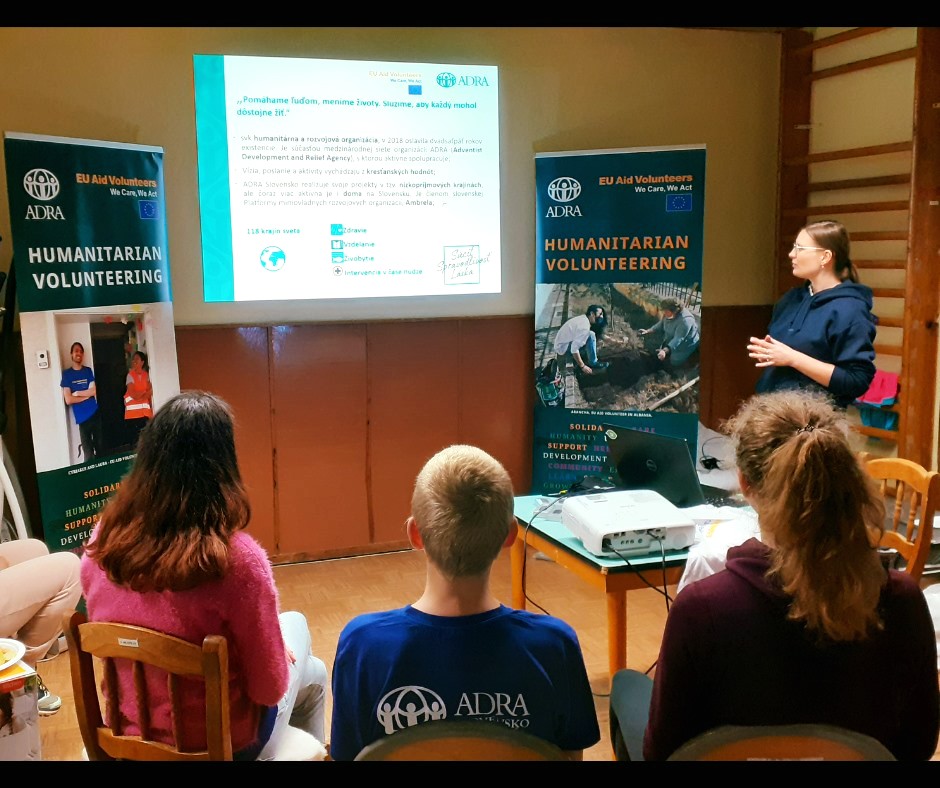
We ended the two-week summer volunteer camp in Pohorelska Maša with a presentation on the EU Aid Volunteers initiative, which, in addition to sending EU volunteers to low-income countries, also involves building the expertise of local organisations through certification. After a long time, we were finally able to realize our „ADRA evening“, although untypical. We introduced our local volunteers to how the whole broadcast cycle works, what all the participating organizations have to manage in order to host a volunteer.
Through short exercises we also put ourselves in the shoes of future volunteers and their host organisations. Based on our own experience from the two weeks in Maša, we prepared a needs assessment, i.e. an assessment of the needs of the Pohorelská Maša social services home. In three groups we analysed the needs of the home from the perspective of the clients, the staff and the volunteers, and proposed possible solutions.
We believe that the discussion was a pleasant end to our volunteering activities in Masha and at the same time a stimulating encouragement to try volunteering beyond the borders of Slovakia.
September 2021
EUROPEAN SOLIDARITY CORPS OPENS UP TO HUMANITARIAN ACTION
This programme, also known in Slovakia as the European Voluntary Service, is undergoing a change that will bring more opportunities, especially for young people. Part of the change is the transition of EU Aid Volunteers, in which we are also active, to the European Solidarity Corps. The ambition is to create a robust solidarity instrument through which the European Union empowers its citizens to build a more inclusive society, support vulnerable communities and respond to societal and humanitarian challenges. We therefore hope that the programme will also attract more people from Slovakia to try volunteering in a humanitarian context.
We are also preparing for these new opportunities with our partners. We have been working hard over the last few weeks to apply for the Quality Label certificate. This is a process that demonstrates our mastery of quality volunteer management, our ability to meet security challenges, as well as our commitment and capacity to act in accordance with the core principles of the programme.
This week marked the first deadline for organisations to apply, which, if successful in obtaining the Quality Label, will allow them to send or host humanitarian volunteers in the new programme as early as next year. However, organisations still have the opportunity to apply and actively participate in the initiative during the 2021-2027 programme period.
Our partners in Serbia, Armenia, Kyrgyzstan and Nepal have already submitted their applications together with us. We believe that we will be successful and next year we will be able to jointly support the deployment of Slovak humanitarian volunteers in the mentioned countries.
HOW TO RUN A SUCCESSFUL VOLUNTEER MISSION?
The answer is the 3 R's: Recruit, Retain, Recognise.
- Selection. Create a realistic volunteer position, select the appropriate communication channels used by your target audience, and ensure equal opportunity for all your candidates.
- Retention. Provide volunteers with mentoring and support not only in their professional development, but also in their daily lives.
- Acknowledgement. Appreciate the major and minor accomplishments of volunteers.

Anna Yeghoyan from YIC Gyumri - Youth Initiative Centre NGO shared with us the key to the success of their numerous volunteer projects during the capacity building training.
Whether you are an organisation interested in managing volunteering projects or a potential volunteer, you can read about the opportunities in the European Solidarity Corps programme here: https://europa.eu/youth/solidarity_sk
October 2021
The question „Why do you want to be a volunteer?" will be asked at every one of our volunteer selection interviews. But have you ever wondered, Why do organisations in low-income countries welcome foreign volunteers? And what do host organisations need to learn and prepare to make volunteer placements successful?
We asked our partners from all corners of the world and got a lot of interesting answers! See for yourself in our new video. The editing and editing of the recordings was done by our former volunteer Jozef Baňás.
If you are not familiar with English, here is a selection of answers:
„We want to move together and bring new perspectives to our work.“ ADRA Serbia
„Our team will be enriched with more diverse skills, while opening the door for volunteers to develop new skills or future employment.“ ADRA Lebanon
„Most of our colleagues started out volunteering and we know the important impact it can have on a young person's life.“ IDEA Central Asia
„Volunteers will bring a piece of Europe to Armenia and European values to our organisation.“ YIC Gyumri - Youth Initiative Centre NGO
„Volunteering is not just about helping, it's about learning and rethinking your worldview.“ Cambodian Youth Action
„Volunteering was basically at the birth of our organisation. Volunteers bring us a breath of fresh air and lots of new ideas.“ Volunteers Centre Skopje - Volunteers Centre Skopje
„Volunteers often have specialisms that local staff lack, such as expertise in technology, fundraising or strategic planning.“ WHR Nepal
WHAT IS THE FIRST WORD THAT COMES TO MIND WHEN YOU THINK OF VOLUNTEERING?
Solidarity, help, understanding, service, activism... These are the associations created by participants in our online event on humanitarian volunteering. 
These weeks at ADRA have been marked by the completion of our Towards Effective Humanitarian Volunteering project. Over the past two years, we have been building the capacity of our partner organisations in humanitarian volunteering to effectively prepare to host volunteers in their countries. Together we have trained in eight thematic trainings and prepared for certification in the EU Aid Volunteers and European Solidarity Corps programmes.
We took stock of the successes and challenges together at the final meeting in October, which was traditionally held online and this time also open to the public. Later, we also met with partners in an informal, close circle.

„This was our first project that took place entirely online. Although we faced many difficulties, we couldn't have asked for better partners to lead the project to success. And that deserves to be celebrated! At the last meeting, we „visited“ the partners in their home countries. This time only virtually, but we hope that our paths will soon cross again on the various occasions that lie ahead. One of them is sending and hosting volunteers through the European Solidarity Corps programme,“ concludes our project manager Veronika Zimová.
The final event of the project was moderated by Boba Markovič Baluchová, Communications Manager of the Platform of Development Organizations - Ambrela.
ARE YOU LOOKING FOR VOLUNTEER PROJECTS IN THE HUMANITARIAN FIELD?
So don't miss out on offers from the European Solidarity Corps! The European Solidarity Corps programme will soon bring new opportunities for humanitarian volunteering in low-income countries.
How do you find the right mission or project? A new video from our partner organisation will explain ADICE Association, which was created in cooperation with us and ADRA CZ in the framework of our project Towards Effective Humanitarian Volunteering funded by the European Commission through the EU Aid Volunteers Programme
Read more about the European Solidarity Corps here: https://europa.eu/…/solida…/young-people/volunteering_sk
TOWARDS EFFECTIVE HUMANITARIAN VOLUNTEERING
20.10.2021
Today is the official end of the Towards Effective Humanitarian Volunteering project, which was our first experience with the coordination of the whole consortium within the EU Aid Volunteers initiative. Our task was to prepare seven organisations in low-income countries to host European humanitarian volunteers in cooperation with ADICE Association and ADRA CZ.
Partner organisations in Lebanon, Serbia, Cambodia, Kyrgyzstan, North Macedonia, Nepal and Armenia learned more about safety, communication in humanitarian contexts, managing and mentoring volunteers, as well as about developing internal organisational guidelines through online trainings.
Our partners themselves will tell you more in the final video, which was edited for us by our former volunteer Jozef Baňás.
We thank all partners for a stimulating two years and look forward to further cooperation, hopefully also in the framework of the newly emerging humanitarian volunteer placements under the programme. European Solidarity Corps.
____________________________________________________________________________
Capacity building project Towards Effective Humanitarian Volunteering was supported by the European Commission under the EU Aid Volunteers initiative and managed by the European Executive Agency for Education and Culture (EACEA) in cooperation with the EU's Directorate-General for Civil Protection and Humanitarian Aid Operations (DG ECHO) and the Directorate-General for Education, Youth, Sport and Culture (DG EAC).
 EN
EN  SK
SK