




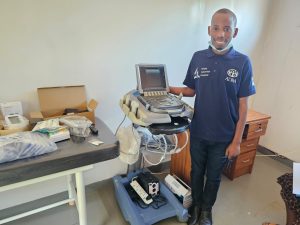
An ultrasound machine for the ADRA hospital in the refugee camp.

The Sonosite M-turbo was donated by a hospital in Austria; I simply transported it and installed it at the hospital built by ADRA Uganda. It is operated by a team of doctors from our partner hospital, Ishaka Hospital.
Shipping the Sonosite to Africa wasn’t exactly easy. We had to disassemble the device and cut up the stand so that everything would fit into three large suitcases. The console with the screen traveled in my carry-on luggage instead of my computer. Fortunately, none of the suitcases went missing, so I was able to reassemble the device and personally deliver it to the hospital. We installed it and put it into operation in the new outpatient clinic.
Doctors and healthcare professionals are thrilled. In addition to the Sonosite, we also brought a fetal Doppler for measuring the baby’s heartbeat inside the mother’s body, blood pressure monitors, stethoscopes, glucose meters, IV sets, digital thermometers, and a variety of small devices and supplies they need.
This hospital, together with the Bugubuli Hospital, cares for 139,000 refugees from the Congo, South Sudan, Rwanda, and Burundi, as well as thousands of local residents in the area. It treats more than 150 patients daily. They were finally able to open an inpatient ward that operates 24 hours a day. All services, including medications, are provided free of charge. But someone has to pay for it…
We began organizing training for the staff on ultrasound. And just then, I received word that Slovak Aid had approved our project to send a volunteer—a doctor—to this hospital. So now it’s clear to us that it will be a radiologist… Once again, I have the feeling that someone is orchestrating all of this behind the scenes and timing it perfectly.

Due to the Ebola outbreak and the influx of refugees from nearby Congo, where Ebola has broken out, stricter epidemiological measures are in place here. Temperatures are checked before entering the facility, and patients with a fever are isolated before being examined. Everything and everyone is constantly being disinfected… The examination rooms and waiting areas are full from early morning until evening. Patients sit in the shade around the building and wait patiently for hours on end. The most heartbreaking sight is that of small children suffering from malaria, which is the most common diagnosis here.
That evening, a desperate mother came to me with her 15-year-old daughter, whose kidneys had failed. To survive, she needs to be hospitalized and requires medication costing more than 500 euros. A muzungu (white person) is her only chance. It’s a difficult decision—who to help and how…
This, too, is one way of encountering the reality of today’s „modern“ 21st-century world.
 EN
EN  SK
SK