




Dominika Tužinčinová worked as a volunteer in ADRA Albania. In her contribution, she presents a new project aimed at combating gender-based violence, which ADRA launched in September 2025 in cooperation with World Vision. Through workshops in the communities of Elbasan and Cerrik, they raised topics that are still extremely sensitive in Albanian society, but all the more important.
. . .
The theme of gender equality and violence has a strong relevance in contemporary Albania. Statistics from 2024 speak clearly: in the first half of the year alone, the police recorded almost 700 cases of domestic violence. In the last 13 years, 159 women have lost their lives at the hands of a partner or family member, an average of one tragedy per month. However, these figures are just the tip of the iceberg of physical violence that takes place behind closed doors.
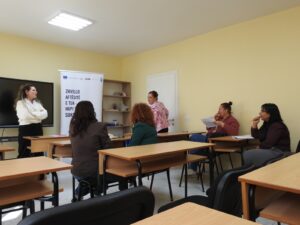
Success in politics vs. reality on the ground
At first glance, Albania appears to be making milestones in the area of women's rights. In Parliament today, women occupy more than 35 % seats, which puts the country at the top of the global rankings. However, the road to this number was not easy and even today it is not without obstacles. Women in politics often face derogatory remarks, stereotyping and psychological pressure from their male colleagues and the media.
Traditional roles still dominate
Outside of political discussions, especially in rural areas and villages, the traditional model of the family, where the man remains the head and sole decision-maker, still persists. This stereotype naturally translates into everyday life and is already visible when you look at public spaces, where you often see almost exclusively men sitting in cafés. The traditional division of roles is also evident when dealing with institutions; it is common for men to accompany women to the doctor or to the authorities and to take the lead in communication, even when the matter concerns the woman directly.
Deep-rooted expectations accompany a woman even after entering marriage. It is often assumed that she will remain in the in-laws' household, where she cares for her husband, his brothers or his father. In some areas, such as Elbasan, these customs go as far as symbolic separation, where women do not sit at the same table as men. Another significant factor is the persistence of arranged marriages, which can change a young woman's life from one day to the next - for example, by abruptly moving from dynamic Tirana to the remote countryside, which often means the end of her ambitions for her own career development.
The extreme consequences of poverty
In the poorest sections of society, gender inequality can grow to tragic proportions. Stories of daughters being „sold“ into marriage because of family financial problems are unfortunately not a thing of the past and often end in violence or family breakdown. Women in Roma communities are specifically vulnerable, facing social exclusion and poverty in addition to gender discrimination, which makes it difficult for them to access help or report violence.
ADRA breaks stereotypes
ADRA Albania's project in the communities of Elbasan and Cerrik combats domestic violence through education. Here, children, parents and professionals learn to recognise different forms of coercion and create 'safety maps', clear instructions on where to turn in an emergency.
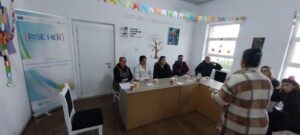
Although the workshops take place in a safe environment, the discussions revealed deep-rooted barriers. Many women admitted that although they know about the possibilities for help, they rarely report incidents, and mostly only when they are physically assaulted. This is because there is a belief that family disputes belong behind closed doors and should be dealt with by relatives, not the authorities.
Participants talk openly about the dominant position of men in society, which they often perceive as an immutable fact. At the same time, however, they call for change and for both parents to have equal responsibility in parenting. It is the breaking down of these stereotypes that is the key to making security and equality a reality for local families, not just a statistic in the project.
The path to change
Although the mentality of Albanian society still allows gender inequality in many ways, the situation is beginning to move forward. There are a growing number of initiatives that seek to change the status of women and girls. Projects like ours, in collaboration with World Vision, are key to educating a new generation. The aim is to make gender equality a reality not only in parliamentary statistics, but especially in the everyday lives of Albanian families.
. . .
The deployment of volunteers is funded by the Official Development Assistance of the Slovak Republic.
 EN
EN  SK
SK